
Premcar turns 30 in 2026. To celebrate, we’re sharing some of our carmaking knowledge. This time, it’s about how motorsport partnerships make better new cars.
The saying “Racing improves the breed” comes from the world of horses, not cars.
It’s the idea that competition improves an equine bloodline, creating ever-better race horses in the future.
The automotive world started applying it over a century ago by using motor racing to make better cars and higher sales.
It was called “race on Sunday, sell on Monday”.
In Australia at least, many people think this idea ended when Ford and Holden stopped making local V8-powered sedans.
That’s not true.
The image of competition and associating brands with popular sports and sporting personalities shows it’s still business as usual.
More importantly, motorsport-derived technical innovations and manufacturing methods are still used.
We’ve used them for decades.
One example is the Ford ‘Miami’ supercharged V8 engine we developed and manufactured via our JV with Ford Australia, Ford Performance Vehicles (FPV), more than 15 years ago.
Its lubrication system is a great case in point.
There were few engine dynamometers (which are used to develop, test and measure an engine’s power and torque levels) that could withstand this engine’s sustained torque delivery.
So we worked with our sister company, Australia’s Ford Performance Racing (FPR), inside their engine test cell.
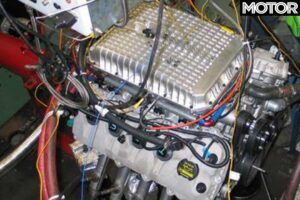
The FPR dyno was built specifically to simulate racing conditions, so it had the wherewithal to cope with the Miami engine’s brutal outputs.
Amongst other things, we used that facility to develop the Miami engine’s unique engine lubrication system. We built an engine tilt rig that tested the engine at extreme angles, right through the engine’s operating range under extreme loads, simulating the cornering, braking and acceleration forces it would be subjected to under the most extreme conditions.
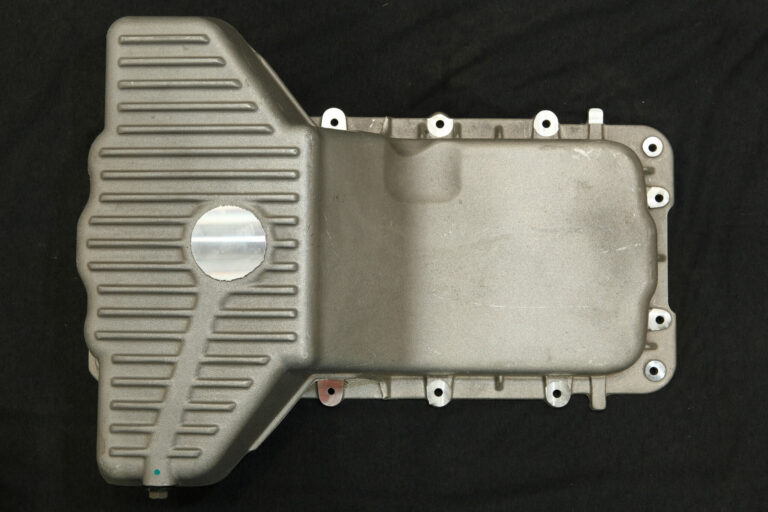
That single dyno function helped determine the Miami engine’s critical engine oil distribution, right down to the piston cooling jets’ function and the design of its engine oil sump.
For all you muscle car fans, it’s why this engine has ‘ears’ on its sump like those on the 1972 Falcon GT HO Phase 4, of which only four were made.
(Innovation isn’t only about looking forwards, it’s also about looking to now – and the past).
Motor racing has always given us effective technical answers.
It’s also given the world better and safer cars.
The Le Mans 24 Hours race helped usher in disc brakes.
Formula 1 gave us underbody aerodynamics, carbon fibre monocoque chassis structures and semi-automatic gearboxes. (And m-u-c-h more).
Racing also helped deliver dual-clutch transmissions, active suspension systems and composite brake materials into driveways everywhere.
In our own new-car development, we still use simulation-based tools and rapid prototyping methods that found their feet in racing.
In carmaking, not all innovation comes from super computers and AI.
Racing-derived technologies, materials and processes aren’t old-world ideas.
They’re still today’s ideas. And they’ll be here tomorrow.
Even for EVs, motorsport partnerships are helping drive your next car. They’re as relevant as ever.
Bernie Quinn, CEO of Premcar
About Premcar:
Premcar Pty Ltd is a leading Australian vehicle engineering business that specialises in the automotive, defence and aerospace industries. For 30 years, global car-makers have made Premcar their go-to partner for the complete design, engineering and manufacture of niche-model new cars, full-scale new-vehicle development programs, and electric vehicle (EV) conversions and manufacturing. Premcar’s body of work is extensive. It is the name behind more than 213,000 new cars and 55,000 new-vehicle engines. The company has delivered technical advancements and sales success for major car brands from Europe, the USA, Japan, China and Australia. Visit premcar.au.